Location

Wasps Around Your Home or Business Are Not Something to Sit On.

Finding a wasp nest under your eave or in a garden bed is one thing.

Discovering that the constant buzzing inside your wall is actually a European wasp colony with tens of thousands of occupants is a completely different situation. Both need to be dealt with. Neither is a job for a can of spray from the hardware store.

Wasps get aggressive fast. Unlike bees, they sting repeatedly without dying. When a nest feels threatened, the whole colony responds at once. A nest disturbed by a lawnmower, a child’s ball, or someone reaching into a garden bed without looking can cause a serious number of stings within seconds. For anyone with an undiagnosed allergy, that’s a medical emergency.

Melbourne’s warmer winters have made things worse. More queens are surviving through to spring, nests are getting established earlier, and what used to peak in late summer is now a problem Melbourne households deal with from September right through to May.

Melbourne 24×7 Pest Control finds the nest, identifies the species, and treats it the right way. We’re available around the clock because a wasp nest near a doorway or children’s play area really can’t wait.

Wasp Species We Treat Across Melbourne

Species identification matters before any treatment is done. An open paper wasp nest under an eave needs a completely different approach to a European wasp colony buried in a wall cavity.

European Wasps are behind the most serious jobs we attend in Melbourne. They’re an introduced pest with no natural predators, so populations grow fast and go unchecked. Their nests hide inside wall voids, roof spaces, and underground cavities. Most people don’t know they have one until the colony is already enormous. A mature nest can hold tens of thousands of workers. They’re drawn to food, sweet drinks, and protein scraps, which makes outdoor dining areas and barbeques prime territory over summer.

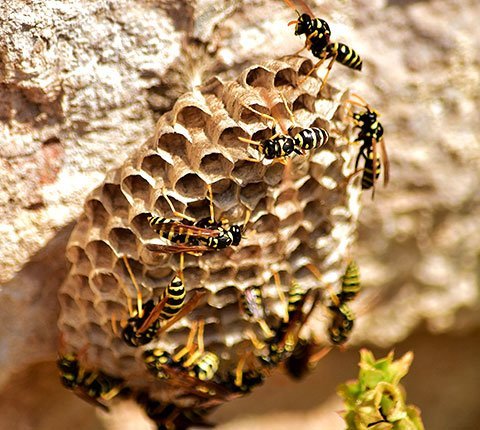
Paper Wasps are native to Australia and the most commonly visible nuisance around Melbourne homes. They build open, umbrella-shaped nests under eaves, inside garden sheds, on fences, under outdoor furniture, and inside letterboxes. Less aggressive than European wasps, but they will sting if the nest is disturbed. Straightforward to treat when approached correctly.

Mud Dauber Wasps build small, tube-shaped mud nests on brick walls, rendered surfaces, and under eaves. Solitary and not aggressive at all. Clients want them removed mainly for cosmetic reasons, and treatment is simple.

English Wasps are less common but do appear in Melbourne’s outer suburbs and regional areas. They behave much like European wasps and are equally capable of building large hidden nests inside building structures.

Why DIY Wasp Treatment Is Genuinely Risky

The problem with tackling a wasp nest yourself isn’t just that it might not work. It’s that getting it wrong can put you in hospital.

When a wasp is killed, it releases a chemical signal that tells the rest of the colony to go into defensive mode. So you spray a few wasps near the entrance, think you’ve handled it, and within seconds you’ve triggered a response from hundreds more. With a European wasp nest inside a wall, that response can come pouring out of gaps you didn’t even know existed.

Retail sprays only knock down the foragers you can see. They don’t reach into the nest where the queen and the bulk of the colony are sitting. The nest rebuilds. The problem continues.

Professional treatment is applied directly into the nest structure with the right product for the species. It targets the colony at its core. That’s not the same job done with better gear. It’s a completely different approach.

How We Handle Wasp Jobs

Every job starts with properly locating the nest. With European wasps especially, the entry point you can see is rarely where the nest actually sits. We track forager flight paths and check roof voids, subfloor spaces, wall cavities, and underground entry points before treatment begins.

Once we’ve found it, we apply a targeted insecticide treatment directly into or onto the nest, remove accessible nest material, and advise on sealing entry points to stop reestablishment.

Accessible outdoor nests are usually done in a single visit. Nests inside building structures get a full explanation of what’s involved before we do anything.

We also cover outdoor entertaining areas, garden sheds, and perimeter zones where wasps are active but no nest has been found yet.

Covering All of Melbourne, Every Day of the Year

We service the full metropolitan area including inner suburbs, outer north, south, east and west, and the Mornington Peninsula. Residential homes, rentals, strata complexes, restaurants, schools, childcare centres, offices, and industrial sites.

Same-day and emergency callouts are available every day including weekends and public holidays.

Don’t Wait Until Someone Gets Stung

๐Ÿ“ž 0450 510 555

Melbourne 24×7 Pest Control. Licensed technicians. Proper treatment. Guaranteed results.

FAQ - Wasps Control Melbourne

This is actually one of the trickier wasp situations and it’s very common with European wasps in particular. Their nests are almost always hidden from view, usually underground, inside wall cavities, or in roof voids. The wasps you’re seeing in the garden are foragers returning to a nest that may be metres away or even next door. Watch where they’re flying to rather than where they’re coming from. If you’re seeing a consistent flight path converging on a single point repeatedly, that’s your nest location. If you can’t track it down, call us and we can help locate it before it gets any bigger.

First, get away from the area as fast as possible and get indoors or into a vehicle. Don’t swat at the wasps as you’re moving because that triggers further stinging. Remove any stings still lodged in your skin by scraping sideways with a fingernail or card, not squeezing them out. Apply a cold pack to reduce swelling. Watch closely for signs of an allergic reaction including throat tightening, difficulty breathing, swelling beyond the sting site, dizziness, or nausea. If any of those appear, call 000 immediately. Once the immediate situation is under control, call us to deal with the nest before anyone else goes near that area.

European wasps can, yes. A large colony inside a wall cavity or roof void over a full season will chew through timber and plasterboard to expand their nest space. The paper material they use to build the nest absorbs moisture and can cause damp damage to surrounding timber and insulation over time. Nests that are left untreated through an entire season can cause structural damage that’s expensive to repair. Getting onto a European wasp nest early in the season is always better than waiting.

It depends on the time of year. Over winter, European wasp colonies do reduce in activity significantly as temperatures drop and worker numbers decline. But in Melbourne’s increasingly mild winters, many nests don’t fully die off the way they used to. A nest that looks quiet in July can be very active again by September with new workers being produced. Don’t assume a quiet nest is a dead one. If you’re not sure, keep clear of it and give us a call to assess it.

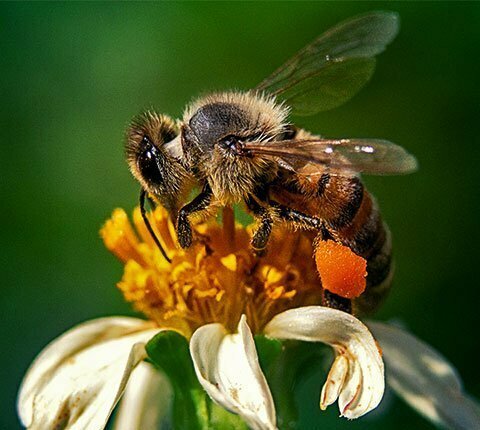
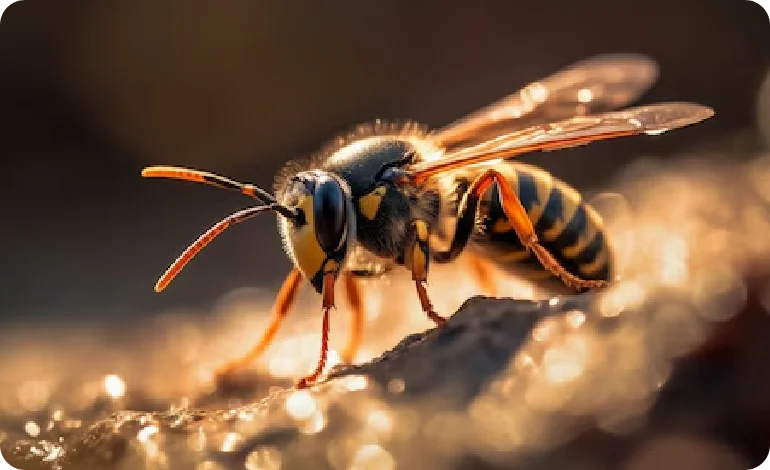
The quickest visual difference is body shape. Wasps are longer and leaner, with yellow stripes built into their skin, while bees have a stout oval shape with fuzzy yellow markings across their body. Pestline Wasps also have a very distinctive narrow waist pinching the body into two sections. In terms of behaviour, wasps are faster and more erratic in flight and tend to be found around food and rubbish, not just flowers. If you’re still not sure what you’re looking at, take a photo and call us. Getting the species right matters before any treatment is done.

Yes, treat it as urgent. A nest inside a roof void is protected from the elements, which means the colony grows larger and survives longer than outdoor nests. By late summer, a roof void nest that was established in spring can be enormous. The entry point is usually through a gap in the fascia, around a roof penetration, or through a cracked tile. The wasps inside are well-protected and extremely defensive. This is not a job to attempt yourself. Call us and we’ll locate the entry point, treat the colony correctly, and advise on sealing the access once it’s done.

Keep kids away from any area where you’re seeing consistent wasp activity, particularly near ground-level holes, garden beds with dense cover, retaining walls, and anywhere near the building perimeter. Don’t leave sweet food or drinks outside uncovered. Avoid wearing strong floral fragrances outdoors during this period. If a wasp lands on someone, stay still and let it move on rather than swatting it. Tell the kids clearly not to investigate holes in the ground or gaps in walls. Call us as soon as possible rather than waiting. A wasp nest near children is an urgent job and we’ll prioritise getting to you quickly.

For a small, accessible paper wasp nest that you’ve successfully treated, probably not. Paper wasp nests are far less dangerous than European wasp colonies and if you’ve dealt with it and the activity has stopped, you’re likely fine. Just leave the empty nest in place for a week or two before removing it to make sure the colony is completely gone. Where you do need professional help is if activity continues after treatment, if the nest is inside a structure, or if you’re not confident you’ve dealt with the whole thing. And if there’s any chance it’s a European wasp nest rather than a paper wasp nest, call us before doing anything.

European wasp queens don’t reuse old nests. Each spring a new queen builds a completely new nest from scratch. But they absolutely will establish a new nest in the same location or nearby if the conditions that made it attractive are still there. A sealed void, a sheltered gap, or a quiet garden corner will keep drawing new queens year after year. Sealing entry points after nest removal is the most effective prevention. A residual perimeter spray in early spring before nesting season begins also helps discourage new queens from getting started.

Call 0450 510 555 any time. We’re available 24 hours a day, 7 days a week including weekends and public holidays. If the situation is urgent, say so when you call and we’ll prioritise getting a technician to you as quickly as possible. Same-day callouts are available for dangerous nest situations.

services

Expert solutions for every pest problem

Ants Control

Professional ant extermination services to eliminate colonies and prevent reinfestation.

Cockroach Control

Professional cockroach extermination services for homes and commercial spaces.

Spider Control

Safe and effective spider control treatments for homes and businesses.

Bee Control

Professional bee hive removal and relocation services.

Wasps Control

Safe and professional wasp nest removal services for homes and businesses.

Rodent Control

Complete rodent control solutions to eliminate rats and mice from your property.

Bed Bug Control

Professional bed bug treatment services to eliminate infestations quickly.

Termite Control

Comprehensive termite inspection and treatment services to protect your property.

Fly Control

Professional fly control treatments for homes, restaurants and commercial spaces.

Moth Control

Effective moth control solutions to protect clothing and stored food items.

Rat Removal

Professional rat removal services to eliminate infestations safely.

Mites Control

Advanced mite treatment solutions to protect your home and family.

Bird Control

Professional bird control solutions to prevent nesting and property damage.

Possum Removal

Humane possum removal and relocation services for residential and commercial properties.

Silverfish Control

Professional silverfish control treatments to protect your home and stored items.

Areas We Serve

Providing reliable and effective pest control services across multiple locations